Adult Children of Narcissists: Recognizing the Long-Term Effects
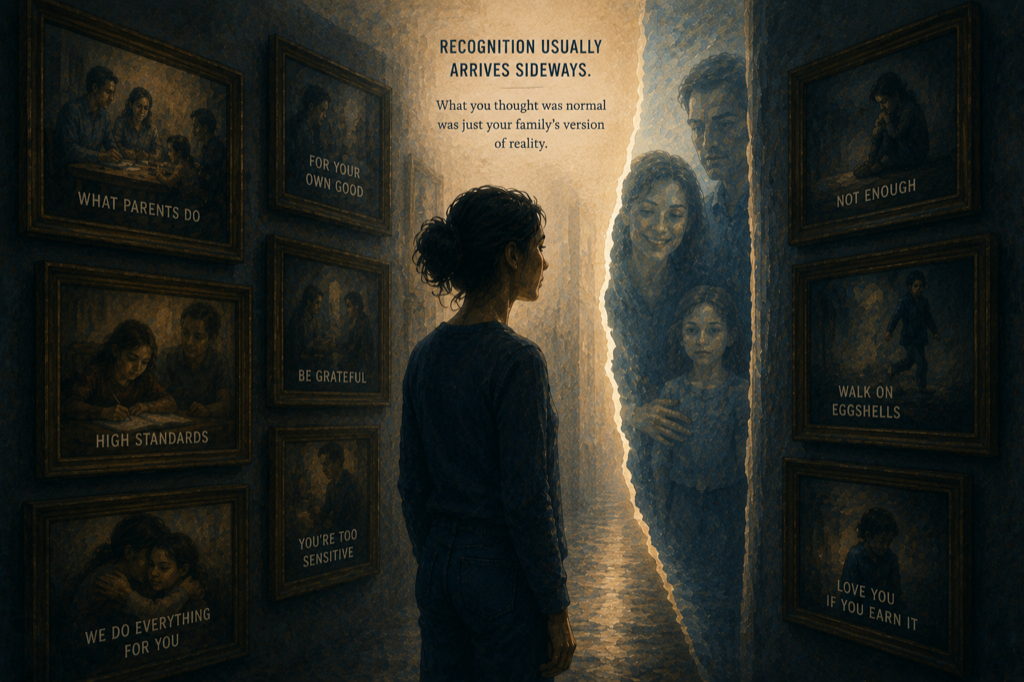
You didn't leave childhood unaffected. You left with adaptations: ways of moving through the world that made sense inside a narcissistic family. The trouble is those adaptations don't stay in the house that built them.
They travel with you. Into friendships, work, romance, parenting, and your relationship with yourself. Often for years before you connect the dots.
Why Recognition Comes So Late
Narcissistic parenting is hard to see from inside the family. As a child, your parent's version of reality is the only one you have. What they do feels like what parents do. The anxiety, the sense of never quite measuring up, the constant scan of someone else's mood feels like your personality, not a response to an environment.
Recognition usually arrives sideways: a friend's family, a partner's family, therapy, a book that describes your childhood with uncomfortable accuracy. You start to see that what you assumed was universal was actually specific to your home.
That shift is disorienting. It raises hard questions about your childhood, your family, and the story you've told yourself about who you are.
Common Long-Term Effects
Chronic self-doubt and imposter syndrome. A parent who questioned your perceptions, criticized your judgment, or treated themselves as the authority on your reality can install a habit of second-guessing that outlasts the relationship. Many adult children of narcissists struggle to trust their competence or to take in praise, because approval was conditional and the internal critic was loud.
Hypervigilance to others' emotional states. If you spent childhood reading a parent's mood, trying to stay ahead of what might set them off, you may still track other people's feelings more closely than your own. You're attuned to the room; your own needs can feel blurry by comparison.
People-pleasing and difficulty with limits. When survival meant staying agreeable and not making waves, that strategy doesn't automatically retire in adulthood. Saying no, asking for what you need, or holding a limit with someone who pushes back can feel dangerous even when the danger is gone.
Attraction to familiar dynamics. People often gravitate toward what's familiar. Intermittent warmth, love that has to be earned, the feeling of never quite being enough can register as intimacy because that's what love felt like growing up. Many adult children of narcissists land in adult relationships that replay the old pattern before they notice the resemblance.
Difficulty identifying your own needs and feelings. In enmeshed families, your inner life may have mattered mainly in how it affected the parent. Over time, knowing what you feel and want, separate from what others feel and want, can become genuinely hard.
The inner critic. A persistent voice that sounds like the narcissistic parent: You're not good enough. Who do you think you are? You always mess this up. It feels like your voice. Often it isn't, and it can take years to hear it as something you absorbed rather than something you are.
Fear of conflict. When conflict in childhood led to punishment, escalation, or withdrawal of love, disagreement stays threatening. Avoiding conflict can make it hard to advocate for yourself, address real problems, or set limits without intense anxiety.
Relationship Patterns
The relational fallout deserves its own look, because it's often where the damage shows up most clearly in adult life.
The rescuer pattern. Some adult children of narcissists gravitate toward people who need fixing, saving, or endless emotional care. That role is familiar. It can feel like love while your own needs stay at the back of the line.
Staying too long. People-pleasing, conflict avoidance, mistrust of your own perception, and deep familiarity with conditional love can make leaving harmful relationships unusually hard. You may see the warning signs and still feel stuck. Each obstacle usually has a childhood root.
Over-apologizing and accepting blame. If you were the scapegoat, or simply the child blamed for things beyond your control, you may apologize reflexively, take responsibility that isn't yours, and treat other people's bad moods as your fault.
Difficulty receiving care. Care that came with strings can make genuine warmth feel suspicious. You may push support away or feel unworthy when someone shows up for you without conditions.
The Recovery Path
Recognition is the first step. When you understand that specific patterns have roots in what you survived, your relationship to those patterns can change.
Recovery work often includes:
Individual therapy with someone who understands narcissistic family dynamics, to make sense of the past and practice different patterns in the present.
Separating from the parent's voice. Noticing when the inner critic is speaking and treating it as external in origin. You may not silence it quickly, but you can stop treating it as the final word.
Grief. Grieving the parent you didn't have and the childhood that wasn't available to you. That grief is real, and it often needs room before it loosens.
Building new patterns. Relational habits from the family of origin can shift through therapy, safer relationships, and slowly expanding tolerance for vulnerability and difference.
Community with people who understand. Hearing your experience described clearly by someone else can be validating in its own right, and it offers models for what recovery can look like.
If a parent's message thread still leaves you apologizing for things you didn't do, paste it into DARVO.app/analyze. Naming denial, guilt, and reversal tactics is often the first step back toward your own reality.