Complex PTSD vs. PTSD: Why the Distinction Matters for Recovery
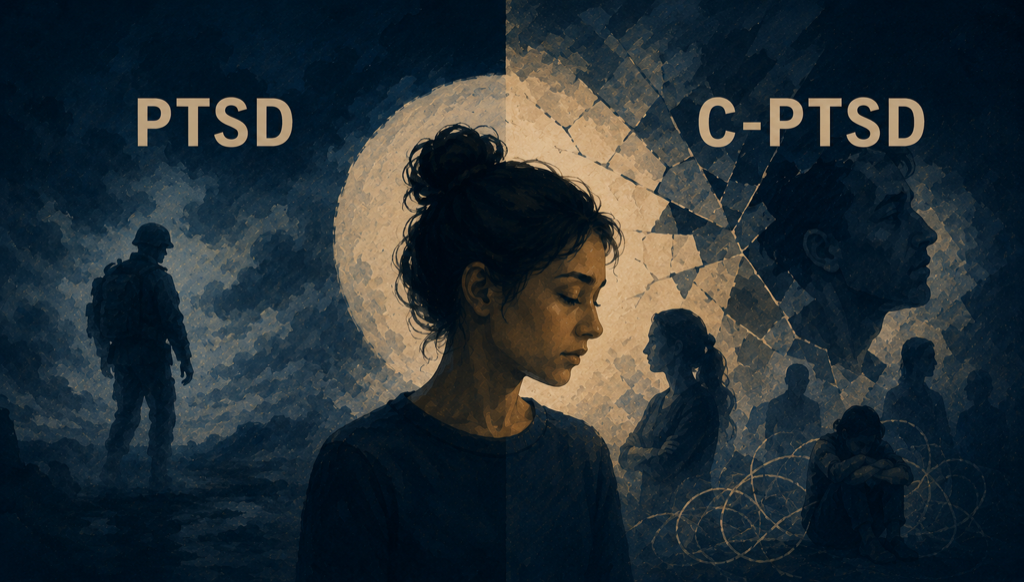
You have probably heard of PTSD. For many survivors of narcissistic abuse and prolonged relational trauma, the standard PTSD frame does not quite fit your lived experience. The mismatch matters, because treatment that fits the injury works better than treatment that does not.
Complex PTSD, or C-PTSD, is often the more accurate description after sustained narcissistic abuse. Understanding the difference can change how you understand your symptoms, which approaches are most relevant, and what recovery can realistically look like.
PTSD: The Original Framework
PTSD, as defined in the DSM-5, is primarily tied to exposure to a discrete traumatic event or a bounded series of events: a car accident, assault, combat, a natural disaster.
Core features reflect that origin:
Re-experiencing — intrusive memories, flashbacks, nightmares linked to the traumatic event.
Avoidance — steering clear of people, places, thoughts, or feelings tied to the trauma.
Negative alterations in cognition and mood — distorted beliefs about self or world, persistent negative mood, diminished interest.
Hyperarousal — exaggerated startle, sleep problems, trouble concentrating, irritability.
Evidence-based PTSD treatments such as Prolonged Exposure and Cognitive Processing Therapy are largely organized around processing specific traumatic memories.
Why Narcissistic Abuse Often Doesn't Fit
The PTSD framework assumes a relatively identifiable traumatic event or series. Narcissistic abuse often does not work that way.
There may be no single worst incident. Harm can be cumulative: thousands of smaller events over months or years. Gaslighting. Intermittent coldness. Criticism. Monitoring. Erosion of selfhood so gradual you only see it when it is severe.
Many survivors struggle with the question "What was my trauma?" The answer is not one event. It is a pattern across years. That pattern often produces effects different from discrete-event trauma and needs a different frame to understand and treat.
Complex PTSD: What It Describes
Complex PTSD was first described by psychiatrist Judith Herman in her foundational 1992 book Trauma and Recovery, and developed further by clinicians including Bessel van der Kolk and Pete Walker. It describes the effects of prolonged, repeated trauma, often where escape was difficult and the perpetrator had power.
Contexts it was built for include childhood abuse, domestic violence, prolonged captivity, cult involvement, and sustained narcissistic abuse: trauma as a relational environment, not a single blow.
C-PTSD includes core PTSD features plus additional effects common after sustained relational trauma:
Emotional dysregulation. Difficulty managing emotional responses, intense reactions that feel disproportionate, trouble returning to baseline, feelings that seem larger than the current moment warrants. Not only anxiety, but a system shaped by years of regular overwhelm.
Negative self-concept. Deep beliefs about being defective, worthless, shameful, or fundamentally different. Not situational low confidence, but pervasive shame and "less than."
Disturbances in relational patterns. Trust struggles, difficulty with closeness and distance, patterns of revictimization, difficulty tolerating genuine intimacy. Relationships shaped by the old template rather than by healthy attachment.
Why the Distinction Matters for Treatment
Standard PTSD treatments focused on processing specific memories can be ineffective or harmful for complex presentations when:
There may be no discrete memory to process. If harm was cumulative, there is no single "worst event" that, once processed, clears the symptoms. The material is spread across years.
Emotional dysregulation may need to come first. Many people with C-PTSD need extended work on regulation skills before trauma processing is safe. Processing too early can re-traumatize rather than heal.
Self-concept work is central. Standard PTSD treatment does not primarily target the deep negative self-beliefs that are core in C-PTSD. Schema therapy, Internal Family Systems, and EMDR with C-PTSD adaptations speak more directly to that layer.
Relationship is part of the medicine. Because the trauma happened in relationship, recovery is substantially relational too. A safe, consistent, boundaried therapeutic relationship is healing in itself, not only a container for techniques.
Therapeutic Approaches Better Matched to C-PTSD
Phase-based treatment. A common C-PTSD framework has three phases: safety and stabilization (regulation and basic safety), trauma processing (when regulation is adequate), and integration (building a coherent narrative and life). Phase one is often longer and more important for C-PTSD than for standard PTSD.
Internal Family Systems (IFS). Works with the internal landscape complex trauma creates: protective parts, exiled parts, shame-carrying parts, rather than only with isolated memories.
Schema therapy. Addresses deep beliefs and patterns formed in childhood or sustained trauma, aligned with C-PTSD disturbances in self-concept and relationships.
EMDR with C-PTSD adaptations. More preparation, different target selection, more stabilization and resourcing before processing than standard protocols.
Somatic approaches. Because C-PTSD is profoundly embodied (hypervigilance, dysregulation, chronic stress), body-based work is often central, not an add-on.
A Note on the DSM
Complex PTSD is not in the DSM-5, though it is included in the ICD-11 (WHO classification). Some US clinicians do not use the term diagnostically, and insurance may not list it. The clinical understanding of complex trauma is still well developed, and many trauma specialists work in this framework regardless of the billing label.
If you are in treatment for what you believe is C-PTSD, ask your therapist about their experience with complex trauma and their approach. The framework matters.
When you are not sure whether your symptoms fit PTSD or C-PTSD, documenting patterns in messages can clarify what you are still living with. DARVO.app/analyze helps you name manipulation tactics in ongoing contact so you can bring concrete examples to therapy, not only a fog of "something feels wrong."