Hypervigilance After Narcissistic Abuse: What It Is and How to Wind Down
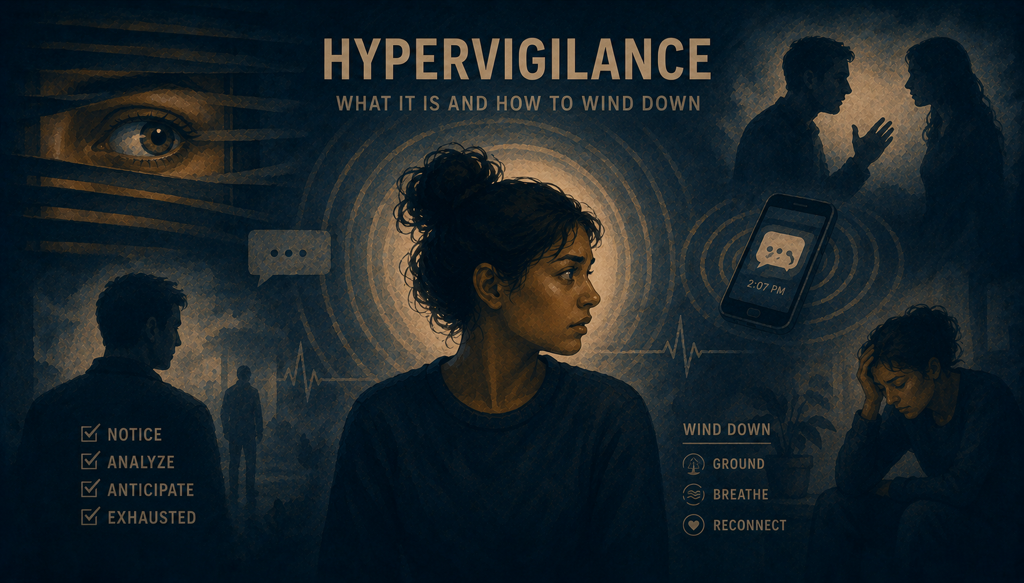
You notice everything. The slight shift in someone's tone. The pause before an answer that feels a beat too long. The text that takes two hours when it usually takes twenty minutes. The way someone looked at you across the room.
You notice, you analyze, you try to read what it means. Is something wrong? Is someone angry? Is something about to happen? You are exhausted. Not because noticing is foolish. You are often right. But because it never stops.
That is hypervigilance. It is one of the most common and draining effects of prolonged narcissistic abuse. And it makes sense, given what your nervous system had to learn.
Why Your Nervous System Learned to Scan
Hypervigilance is not the same as an anxiety disorder label or paranoia. It is an adaptive response to an environment where threat was real but unpredictable.
With a narcissistic or high-conflict person, danger often had a pattern: you could not predict when the next escalation would come, what would trigger it, or how bad it would get. Quiet was not always safety. Sometimes it was only the pause before the next incident.
Your nervous system responded rationally. It upgraded threat detection. It learned to watch tone, expression, timing, and silence for clues about what was coming. That vigilance was functional. In many moments it bought you a few seconds of preparation that mattered.
The hard part: the upgraded system does not always downgrade when the threat environment changes. You leave, or things stabilize, and the scanner keeps running. It still flags signals as possible danger because that is what it was built to do, and the build is still active.
What Hypervigilance Looks Like Day-to-Day
Constant monitoring of others' emotional states. Not occasional check-ins. A near-continuous background scan of mood, shifts, and micro-changes, often before you consciously decide to watch.
Interpreting neutral behavior as threat. A delayed reply becomes proof of anger. A distracted look becomes displeasure. A tone most people would miss registers as warning. The scanner is sensitive because it was calibrated for an environment that rewarded sensitivity.
Difficulty being in the present. When a lot of bandwidth goes to what might happen next, full presence in the current moment is genuinely hard. Part of you can be in conversation while another part runs threat assessment.
Physical symptoms. Jaw, neck, and shoulder tension. Trouble fully relaxing. Startling easily. Sleep disruption. The body stays in readiness that made sense then and costs you now.
Exhaustion. Sustained vigilance is metabolically expensive. This is not ordinary tiredness from a busy day. It is depletion from being on alert too long.
Testing others. Some people with hypervigilance test partners or friends, looking for the betrayal or cruelty they were trained to expect, sometimes pushing until conflict appears. That can feel protective: better to find out now than when you are more invested.
The Particular Difficulty of Co-Parenting Hypervigilance
If co-parenting means the threat source is still in your life through messages, schedules, or your children, hypervigilance may not fully reset. There is always something to monitor.
That is one of the hardest parts of co-parenting with a high-conflict person: your nervous system may never get a long stretch of "nothing to watch for." Nervous-system work still matters, alongside practical limits: set times to check communications, boundaries on after-hours contact, co-parenting apps that add structure and a record when words do not match actions.
Winding Down: What Actually Helps
Create predictability where you can. Hypervigilance is tuned to unpredictability. Steady routines, reliable people, and environments where words match behavior teach your system that not every moment needs high alert.
Somatic approaches. Hypervigilance lives in the body: muscle tension, physiological readiness, calibrated startle. Talk therapy alone often cannot reach all of it. Somatic experiencing, EMDR, trauma-sensitive yoga, and breathwork speak to the nervous system directly.
Distinguishing real from residual threat. In calmer moments, practice asking: "This feels like a threat. Is there actual evidence of threat here?" That skill builds with repetition, not from a single insight.
Tolerating uncertainty. Much of the scan is driven by intolerance of not knowing. Learning to sit with ambiguity without rushing to resolve it can lower the urgency of the monitoring.
Therapy. A trauma-informed therapist can map your specific hypervigilance pattern, work with the body side, and support recalibration over time.
Time away from the source. Where possible, real distance gives your system sustained safety to begin resetting. Even with required contact, maximizing genuine relief periods matters.
The scanner served you. It protected you as best it could when protection required it. The work now is not erasing awareness. It is turning down the default sensitivity, building a new baseline, and giving yourself the safety experience you were denied.
That takes time. It happens. Your nervous system is not permanently stuck at this setting.
When a co-parent's message sends you into full threat mode, DARVO.app/analyze can help you separate manipulation tactics from boring logistics so your body is not treating every ping like the old fights.