When She's the Narcissist: What Male Victims Are Told vs. What's True
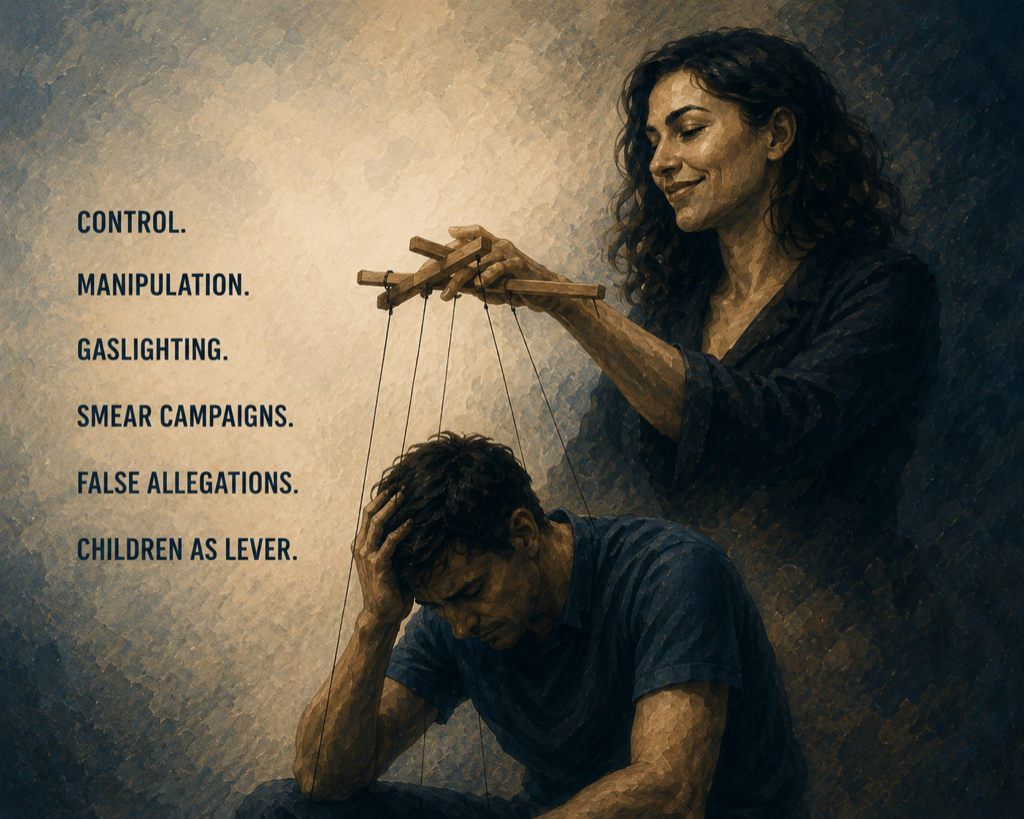
When a man describes being gaslit, controlled, berated, threatened with losing his children, or made to feel like he's losing his mind by a female partner, the responses he gets often have nothing to do with his actual situation.
He's told he must be exaggerating. Or that whatever she did was probably a reaction to something he did first. Or that she's clearly struggling and needs support. Or that real abuse "doesn't work that way" with genders reversed. Or, from other men who've decided they know better: that he should have been tougher, set firmer limits, not let it get that far.
None of these responses help. Most of them compound the harm.
What He's Actually Told
"She seems so nice / everyone loves her." Female narcissists, particularly grandiose and communal types, are often highly skilled at impression management in social settings. The public persona is warm, giving, relationally skilled. The private behavior (coldness, contempt, manipulation) is reserved for the person closest to her, the one she doesn't need to perform for.
The gap between public and private presentation is evidence of manipulation, not evidence against it. Outside observers rarely see what the partner sees, which compounds isolation.
"You're a man — how can she control you?" This reflects a misunderstanding of coercive control. Physical size and strength are not the primary mechanism. Coercive control operates through monitoring, isolation, financial control, threats (especially involving children), emotional manipulation, and systematic erosion of the target's sense of reality and self.
A woman can do all of these things to a man. Size is irrelevant.
"Men can't be victims of abuse." This belief persists despite clear evidence to the contrary. Research on intimate partner violence consistently finds that men make up somewhere between 25-40% of intimate partner violence victims, with rates of psychological and emotional abuse roughly equivalent across genders.
"Just leave." Said as though leaving were straightforward, as though the attachment bond, the trauma bonding, the financial entanglement, the children, the threat of false allegations, and the complete social isolation that narcissistic abuse produces don't exist.
What Female Narcissistic Abuse Actually Looks Like
The core dynamics are the same as in any narcissistic abuse situation. The specific tactics often differ.
Weaponizing emotional vulnerability. Female socialization often includes greater facility with emotional expression, which can be weaponized in specific ways. Explosive emotional displays that require the male partner to manage and soothe. Crying as a control mechanism. Expressed fragility that creates obligation.
Social reputation management. Female narcissists frequently seed narratives with mutual social networks before any confrontation occurs, positioning themselves as the partner who has been struggling, who has tolerated a lot, whose patience has run out. By the time the man tries to tell his story, the narrative has been established against him.
Using children as the primary lever. For male partners who have children, the threat of restricted or terminated access is particularly effective. Courts statistically award primary custody to mothers more often than fathers. A narcissistic mother who threatens to take the children, file false allegations, or poison the children against their father is using a lever that hits a man's deepest vulnerability and is disproportionately powerful in the legal system.
False allegations. This is the tactic that distinguishes female narcissistic abuse from some other configurations. False allegations of domestic violence, sexual assault, or child abuse are more likely to be made against men by female partners than the reverse, partly because the institutional systems are more likely to credit them. A man against whom a false allegation has been made faces both the immediate legal crisis and an overwhelming presumption against him in any subsequent custody proceeding.
Intimate knowledge weaponized. What was shared in vulnerability (insecurities, professional struggles, family history, past mistakes) becomes material for the manipulation, the smear campaign, or the courtroom narrative.
The Specific Legal Vulnerability
The intersection of female narcissistic abuse and the family court system is one of the most serious topics in male survivor experience. This is not a critique of the courts as uniformly biased. Many family court judges work carefully and thoughtfully. It is an acknowledgment of documented statistical patterns.
Men in high-conflict custody situations involving a narcissistic co-parent are more likely than women in the same situation to face false allegations, to lose primary custody regardless of which parent is the more capable caregiver, and to find that their own credible concerns about the other parent's behavior are less likely to be taken seriously.
Documentation is more important for male victims in co-parenting situations, not less. Every communication. Every interaction. Everything timestamped and preserved.
An attorney with specific experience in high-conflict custody involving false allegations is a different type of representation than a general family law attorney, and worth finding.
Closing
If you're a man who has been manipulated, controlled, gaslit, or harmed by a female partner, your experience is real. It has a name. The patterns you lived through are documented, researched, and recognized.
The cultural confusion around who can be a victim and who can be an abuser does not change what happened to you. It only makes it harder to name, which is why naming it matters.
When her messages flip the script or bait you into a fight that becomes evidence against you, paste them into DARVO.app/analyze before you reply. You'll see the tactics and get responses that hold your boundary without escalating.