How to Write a BIFF Response (With Real Examples)
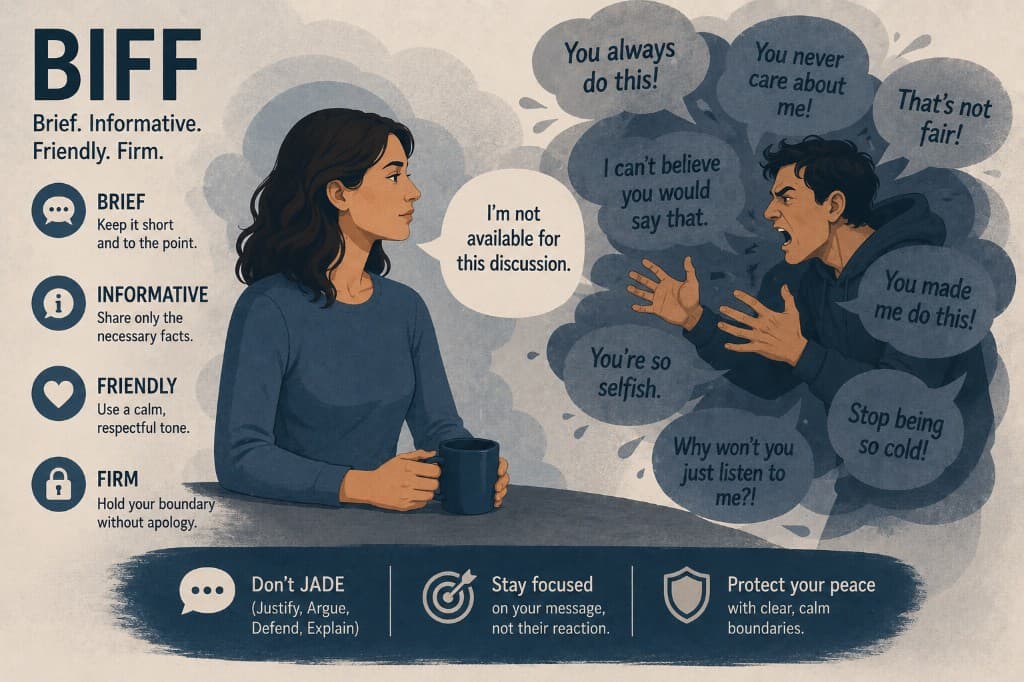
Knowing BIFF stands for Brief, Informative, Friendly, Firm is one thing. Writing one when a message just tightened your chest is another. The principles make sense in the abstract. In practice you're staring at an accusation about your parenting, and "be brief" feels impossible.
This is the practical guide. Real messages. Real BIFF responses. Notes on why each one works.
A Quick Recap
Brief — Two to four sentences. Five at most. Informative — Only necessary facts. No history, no feelings, no justification. Friendly — Professionally cordial. Not warm, not hostile. Firm — Ends somewhere clear. No open invitations for the next five messages.
Bill Eddy's three things to leave out: no Advice, no Admonishments, no Apologies (the Three A's).
Example 1: The Accusatory Schedule Message
Their message: "You are ALWAYS late to pickup. The kids are standing outside waiting in the cold every time. This is unacceptable and I'm documenting it. A good parent would prioritize being on time."
What you want to write: "I have been late once in the past four months, and that was because of a traffic accident on Route 9 that I texted you about. I am consistently early or on time. This is completely unfair and you know it. Don't call my parenting into question."
The BIFF response: "Thanks for raising it. I'll make sure to account for traffic on pickup days. If I'm ever running more than 5 minutes late I'll text ahead. See you Thursday at 5."
Why it works: It doesn't argue the history. It doesn't defend against the accusation. It does exactly what a reasonable person would do — acknowledge the concern and state a specific action. The accusation about being a "bad parent" gets zero response. Responding to it would just validate the premise that it deserved a response.
Example 2: The Holiday Ambush
Their message: "Since you had the kids for Thanksgiving last year, it's obviously my turn this year. I've already made plans with my family and told the kids we're going to Grandma's. Please confirm you understand."
What you want to write: "I did not have the kids for Thanksgiving last year — you did, and there are messages on OFW confirming that. And you cannot make plans involving the kids and then demand my confirmation. That's not how co-parenting works."
The BIFF response: "According to my records and our parenting plan, Thanksgiving rotation gives me this year. I'm happy to share documentation if that would help clarify. Please let me know by [date] so we can both plan accordingly."
Why it works: It states a clear position with a reference to documentation (not a defense — a reference). It doesn't engage with the "obviously" framing or the fact that they've already made plans. It closes with a date and a constructive offer. The presumptive close ("please confirm you understand") gets reframed into a request for their confirmation.
Example 3: The Health Accusation
Their message: "I need to know what the kids are eating at your house because frankly I'm concerned. [Child] came home saying they had fast food three times this week and that's not acceptable. I'm keeping track of this."
What you want to write: "First of all, [child] is 8 and their perception of time is not reliable. Second, what I feed them at my house is my business as their parent. Third, you let them eat [example] which I've never complained about. Mind your own house."
The BIFF response: "The kids eat balanced meals at my home. If there are specific medical or dietary concerns you'd like to discuss, I'm open to that conversation. Otherwise the schedule continues as planned — see them on Friday."
Why it works: One sentence addressing the substance (their meals are fine). One sentence offering a door if there's a genuine medical issue (there isn't, but the offer looks reasonable). One sentence closing the loop. The "I'm keeping track of this" threat receives no acknowledgment whatsoever.
Example 4: The Vague Escalation
Their message: "We need to talk. There are some things going on that I'm not comfortable putting in writing. Call me."
What you want to write: "What things? If this is about the kids, just say it."
Or worse: actually calling.
The BIFF response: "I keep our co-parenting communication in writing so we both have a clear record. Please share what's on your mind here and I'll respond promptly."
Why it works: It declines the phone call without explaining the reasoning (your legal strategy is not their business). It redirects to written communication. It doesn't express suspicion, alarm, or curiosity about what "things" they're referring to. The open-ended anxiety they were trying to create gets a flat, professional redirect.
Example 5: The CC'd Email
Their message (with your mutual attorney CC'd): "I'm writing to document that you have, on multiple occasions, failed to follow the parenting plan. I will be raising this in our next court proceeding. I expect compliance going forward."
What you want to write: (Nothing appropriate, honestly.)
The BIFF response: "Thanks for the message. I've been following the parenting plan as written. If you have a specific concern, please note the date and nature of the incident. I'm committed to the plan and will continue to follow it."
Why it works: It's so boring that everyone CC'd on the email — including the attorney — has just watched you respond to a threat with professional composure. "I've been following the parenting plan" is a clear, undefended position. The invitation to note specific incidents puts the burden on them (they probably don't have specifics — that's why the message was vague). The close is positive and forward-looking.
Example 6: The Emotional Ambush
Their message: "I just want you to know that what you're doing to this family is devastating. The kids cry themselves to sleep. I hope that's worth it to you."
What you want to write: You don't want to write anything. You want to drive over there.
The BIFF response: Option A (if this warrants any response at all): "I love the kids and I'm focused on making this transition as stable as possible for them. If there are specific concerns about their wellbeing, I'd like to address those directly."
Option B: No response. This message has no logistical content. It is pure emotional bait. Silence is complete.
Why it works: Option A is compassionate without engaging with the accusation. Option B recognizes that some messages are not questions and do not require answers. The decision between them depends on context — but both are more powerful than the reactive response they were trying to produce.
Quick BIFF Checklist Before You Hit Send
Ask yourself:
- Is this longer than 4-5 sentences? (If yes: cut.)
- Does it contain any history or reference to past events? (Cut.)
- Does it defend against any accusation? (Cut — or transform into a brief position statement.)
- Does it express frustration, hurt, or anger? (Cut.)
- Does it end with an open question that will generate five more messages? (Rewrite the close.)
- Would a judge, mediator, or mutual friend reading this see a reasonable, composed person? (Yes: send. No: revise.)
For a deeper understanding of the BIFF framework, see BIFF Method: How to Write Messages That Shut Down Manipulation. And if you're not sure how to handle a specific message, paste it into the DARVO analyzer — we'll write a BIFF response for your exact situation.