BIFF Method: How to Write Messages That Shut Down Manipulation
You've just received a message that makes your blood pressure spike. It's accusatory, unfair, and designed to pull you into a fight. You know you need to respond — maybe there's a logistical question buried in there, maybe ignoring it will be used against you later — but every response you draft either sounds defensive or gives them more material to work with.
There's a better way to respond. It's called BIFF, and once you learn it, you'll use it constantly.
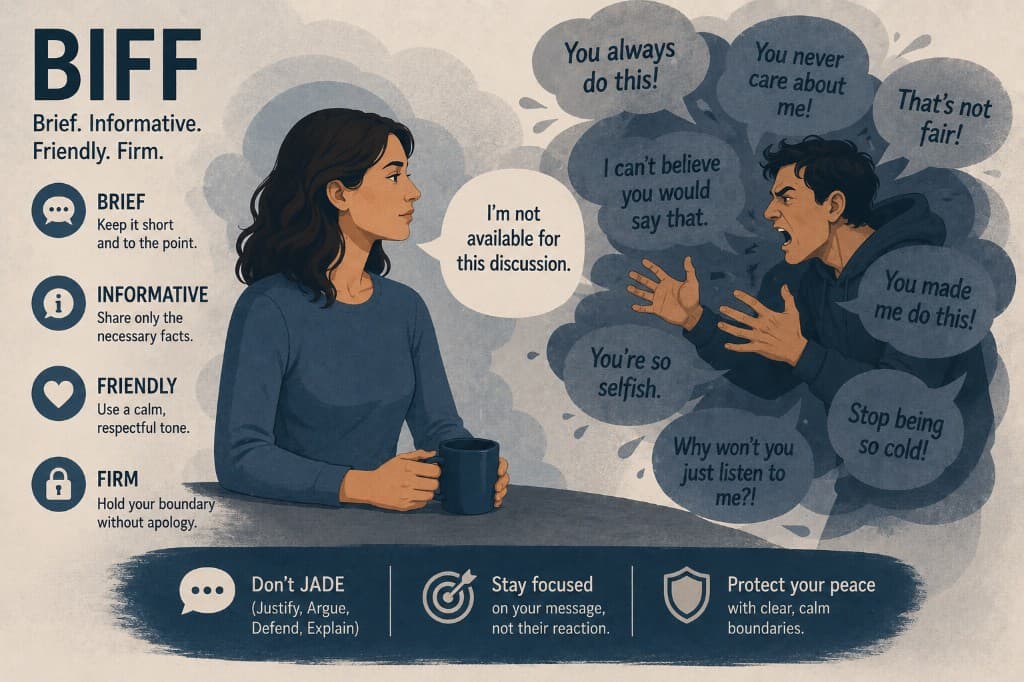
What Is the BIFF Method?
BIFF is a communication framework developed by Bill Eddy, attorney and co-founder of the High Conflict Institute. It was designed specifically for communicating with high-conflict personalities — people who have a persistent pattern of all-or-nothing thinking, intense emotions, extreme behavior, and a tendency to blame others.
BIFF stands for:
- B — Brief
- I — Informative
- F — Friendly
- F — Firm
Each element serves a specific purpose. Together, they produce a response that addresses what needs to be addressed, gives the other person nothing to attack, and closes the loop without leaving doors open for circular argument.
Why High-Conflict Communication Requires a Different Approach
In healthy relationships, normal communication works. You explain your reasoning. You defend your position. You express your feelings. The other person hears you, considers your perspective, and the conversation moves forward.
With high-conflict personalities, that approach backfires. Every explanation becomes ammunition. Every defense is picked apart and turned against you. Every emotional expression is catalogued and potentially used later — in court, with mutual friends, in front of your children.
Normal communication assumes both people are trying to reach understanding. High-conflict communication doesn't have that assumption. One person is trying to communicate; the other is trying to win, control, or destabilize.
BIFF is built for that asymmetry.
Breaking Down Each Element
Brief
Keep it short. Ideally two to four sentences. Five maximum.
Long responses signal engagement. When you write three paragraphs, you're telling the other person that their message got to you — that it rattled you enough to spend significant time crafting a detailed reply. That's information they'll use.
Long responses also give them more to attack. Every sentence you write is a potential point of contention. Every qualification, every explanation, every piece of context is material they can twist, quote out of context, or use to generate the next volley.
Brief doesn't mean cold. It means efficient. Say what needs to be said and stop.
Informative
Include only the relevant facts. No opinions about their behavior. No history of past grievances. No emotional commentary. Just the practical information required to address the situation at hand.
"Per the parenting plan, pickup is at 5 PM on Fridays. I'll have the kids ready." That's informative. It addresses the logistics without inviting debate about anything else.
"Per the parenting plan, pickup is at 5 PM on Fridays — which you've been consistently late for, and I want it noted that this pattern is affecting the children." That's not informative. That's a counterattack wrapped in logistics.
Friendly
This one surprises people. Why be friendly to someone who just sent you an aggressive message?
Because "friendly" in the BIFF context doesn't mean warm or enthusiastic. It means non-hostile. Civil. Professional. The tone of a business email to a colleague you don't particularly like but need to work with.
A friendly opener ("Thanks for the heads up" or "I understand you have concerns about the schedule") immediately de-escalates without conceding anything. It signals that you're not going to fight, which is often enough to prevent the next message from escalating further.
It also looks better. If these messages end up in front of a judge, a mediator, or a therapist, "Thanks for letting me know. Per our agreement..." reads very differently than "I can't believe you're doing this again."
Firm
Firm means your message ends somewhere. There's a clear position, a clear next step, or a clear boundary. It doesn't trail off into questions or leave room for interpretation that could become a new argument.
"Let me know if you have questions" is not firm — it's an open invitation for five more messages. "The schedule stands as written. If you'd like to request a change, please give me a week's notice in writing" is firm. There's a position, a process, and a close.
What BIFF Leaves Out (On Purpose)
Bill Eddy specifically warns against three things he calls the Three A's:
No Advice. Don't tell them what they should do differently, how they should feel, or what they should reconsider. Even well-intentioned advice gives them something to reject and argue against.
No Admonishments. Don't scold, lecture, or point out how their behavior affects others. They know. They don't care, or they'd behave differently. Admonishments feel satisfying to write and accomplish nothing except escalating the conflict.
No Apologies. This one is counterintuitive. An apology in a high-conflict dynamic isn't received as a gesture of goodwill — it's received as an admission. It will be quoted back to you. "Even you admitted that you..." Don't apologize for things that aren't your fault, and be very careful about apologizing for things that are — context matters enormously.
BIFF in Practice: Before and After
The message they sent: "You never told me about the school event on Thursday. I had to find out from another parent. This is exactly the kind of thing that happens when you refuse to communicate properly. I'm starting to think you're deliberately keeping me out of the loop."
The natural response (what you want to write): "I absolutely did tell you — I sent you a message on the 14th which you read and never responded to. I'm not 'refusing to communicate' — you're the one who takes days to respond to anything. And I'm not 'deliberately keeping you out of the loop,' that's insulting and you know it."
This response is understandable, human, and completely counterproductive. It defends, it attacks, it re-litigates, and it gives them three more threads to pull.
The BIFF response: "Thanks for flagging. The school sends event notifications directly to parents listed in the system — you should be receiving those. I'll also make sure to forward the Thursday details now. Let me know if you need the school contact to update your information."
Notice what this does: it addresses the practical issue (how they can get event notifications), offers a concrete next step (forwarding the details), and closes with a path forward. It doesn't defend, doesn't attack, doesn't acknowledge the accusations, and doesn't leave anything open for the next argument.
When to Use BIFF
BIFF works best for:
- Co-parenting logistics — Schedule changes, school updates, medical information, activity coordination
- Workplace communication with a difficult colleague or manager
- Family exchanges where you need to respond but don't want to engage
- Any message that contains accusations you don't want to dignify but can't fully ignore
BIFF works less well for:
- Situations requiring warmth or emotional connection (use it with the people you're co-parenting with, not with your kids)
- Emergencies requiring more detail
- Situations where silence is actually the better option (see: Grey Rock, No Response)
One More Thing: BIFF Is Not About Winning
The goal of BIFF isn't to outsmart the other person or produce the perfect comeback. It's to handle necessary communication efficiently, protect yourself legally and emotionally, and preserve your energy for things that actually matter.
High-conflict people are often skilled at drawing you into exchanges that cost you hours of emotional labor and accomplish nothing. BIFF is a way of refusing that trade without ignoring legitimate communication needs.
Brief. Informative. Friendly. Firm. Four words that can change the texture of your entire communication dynamic — once you practice them enough that they become instinct.
Ready to see BIFF in action? Paste a message you've received into the DARVO analyzer and we'll suggest a BIFF response tailored to your situation.