Fawning: The Fourth Trauma Response Nobody Warned You About
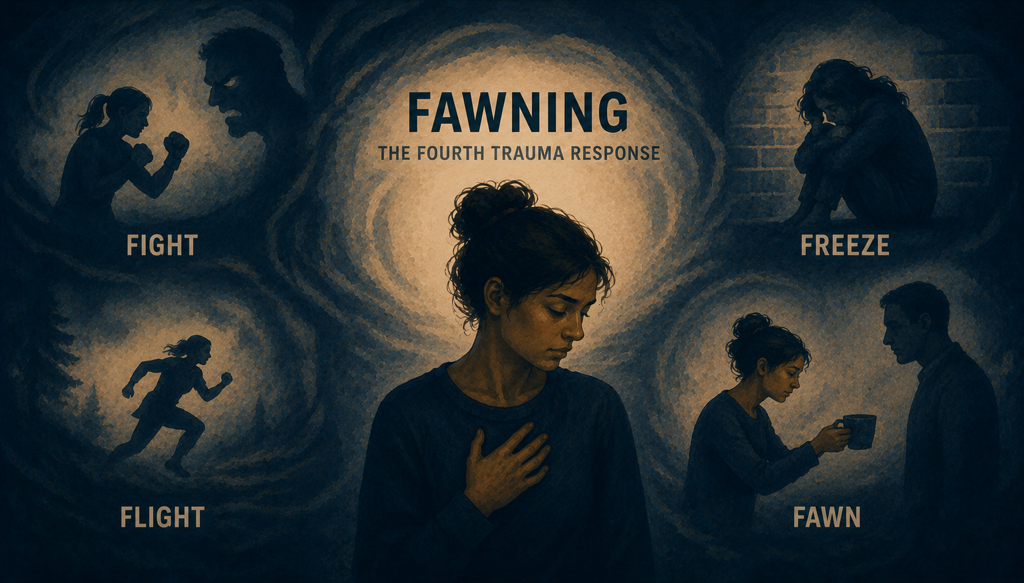
You have heard of fight, flight, and freeze. They are the trauma responses most people know. The fourth one shows up less in conversation: fawning.
Fawning is what happens when fighting is not safe, leaving is not possible, and freezing is not enough. From the outside it can look like cooperation, helpfulness, and agreeableness. From the inside it is often your nervous system managing threat by keeping the other person calm.
What Fawning Is
Fawning (sometimes called appeasement) is a survival strategy where you prioritize the other person's needs, mood, and reactions to reduce immediate danger. If they feel good about themselves and stay regulated, the threat level drops.
Therapist Pete Walker brought the term into trauma work on complex PTSD. He described fawning as common in people who grew up with narcissistic or abusive caregivers: places where fight was dangerous, flight was impossible, and freeze was not enough for day-to-day life.
In those homes, learning to read the caregiver's emotional weather, soothe them, and minimize conflict through accommodation was adaptive. Often it was the safest option available.
The problem is that once it is wired in, it does not stay in the room where you learned it.
What Fawning Looks Like
Because fawning was practiced for years, it often feels like personality, not a response.
Chronic agreement. Difficulty saying no. Automatic agreement even when you privately disagree. Changing your mind when someone pushes back, not because they persuaded you but because disagreement feels unsafe.
Over-apologizing. Apologizing for things that are not your fault. Apologizing preemptively. Apologizing for having needs or taking up space.
Prioritizing others' emotions above your own. You track how everyone else feels and redirect energy to manage them. Their states can feel more urgent and real than yours.
Difficulty identifying your own needs and preferences. Asked what you want, you draw a blank, or you know but cannot say it without fear of conflict. "Whatever you want" becomes so habitual you lose track of what you actually want.
Performing emotions you do not feel. Smiling when you are not happy. Agreeing when you do not agree. Reassuring others when you are the one who needs reassurance.
Giving at the expense of receiving. Generosity that becomes self-erasure. You help, accommodate, and care for others while struggling to accept care back.
Attracting people who use your fawning. Years of appeasement can become visible to people who benefit from someone who automatically puts them first. Narcissistic and high-conflict people often gravitate toward fawning partners, friends, and employees because trained compliance gives them what they need.
The Nervous System Underneath
Fawning is not a moral failing, any more than fight or flight is a choice. It is a nervous system response that often fires before conscious decision-making.
When your system codes conflict, disapproval, a raised voice, or someone's displeasure as threat, appeasement can switch on automatically. You become agreeable, helpful, soothing. You manage the moment.
That happens fast, faster than thought. The strategy runs ahead of any deliberate plan to use it.
Over time the lesson is: when the environment feels threatening, appease. It works short term (the spike may pass). It fails long term (your needs stay unmet, your feelings stay unspoken, your sense of self gets harder to reach).
Fawning in Relationships with Narcissistic People
Fawning can make you especially vulnerable to narcissistic relationships and especially skilled at surviving them in the short term.
A fawning partner often manages the other person's emotional states with painful accuracy. You read warning signs early, adjust before escalation, absorb blame with little visible pushback, and supply steady validation. From their side, that can look like an ideal partner.
You may stay long after leaving would look obvious, because leaving means putting your needs above theirs. That is precisely what fawning makes hardest.
Recognition often arrives through exhaustion: the constant effort of appeasement becomes unsustainable. Or through crisis: realizing there is no stable self under the performance, that years went to their needs while yours went unnamed.
Recovery: Coming Back to Yourself
Recovering from fawn as a dominant mode is, in practice, rediscovering yourself: preferences, needs, emotions, and opinions that were sidelined for safety.
That is slower than it sounds. When the fawning environment ends, the self underneath does not always return on day one. Many people pass through a stretch of not knowing what they feel, want, or who they are apart from the role they played.
Useful practices:
Noticing automatic agreement. Before you agree or accommodate, add a pause. "Let me think about that." "I need to check my schedule." Small delays give a genuine response room to form.
Building tolerance for disapproval. Under fawning, disapproval often feels like danger. Practice small non-accommodation in lower-stakes settings: a preference stated, a mild disagreement, a no without a long justification. Let your nervous system learn that disapproval is not always catastrophe.
Therapy that understands complex trauma. Somatic work, EMDR, Internal Family Systems, and similar approaches work with the body and nervous system, not only with insight in your head.
Choosing relationships that can hold your full self. The goal is contexts where having preferences, disagreeing, and taking space do not automatically trigger the old threat response.
When you are not sure whether you are fawning or simply being kind, a difficult exchange can clarify the pattern. Paste the thread into DARVO.app/analyze to see whether you are managing their mood or responding to ordinary conflict.